Your electric bill is not a weather event. It is a policy document.
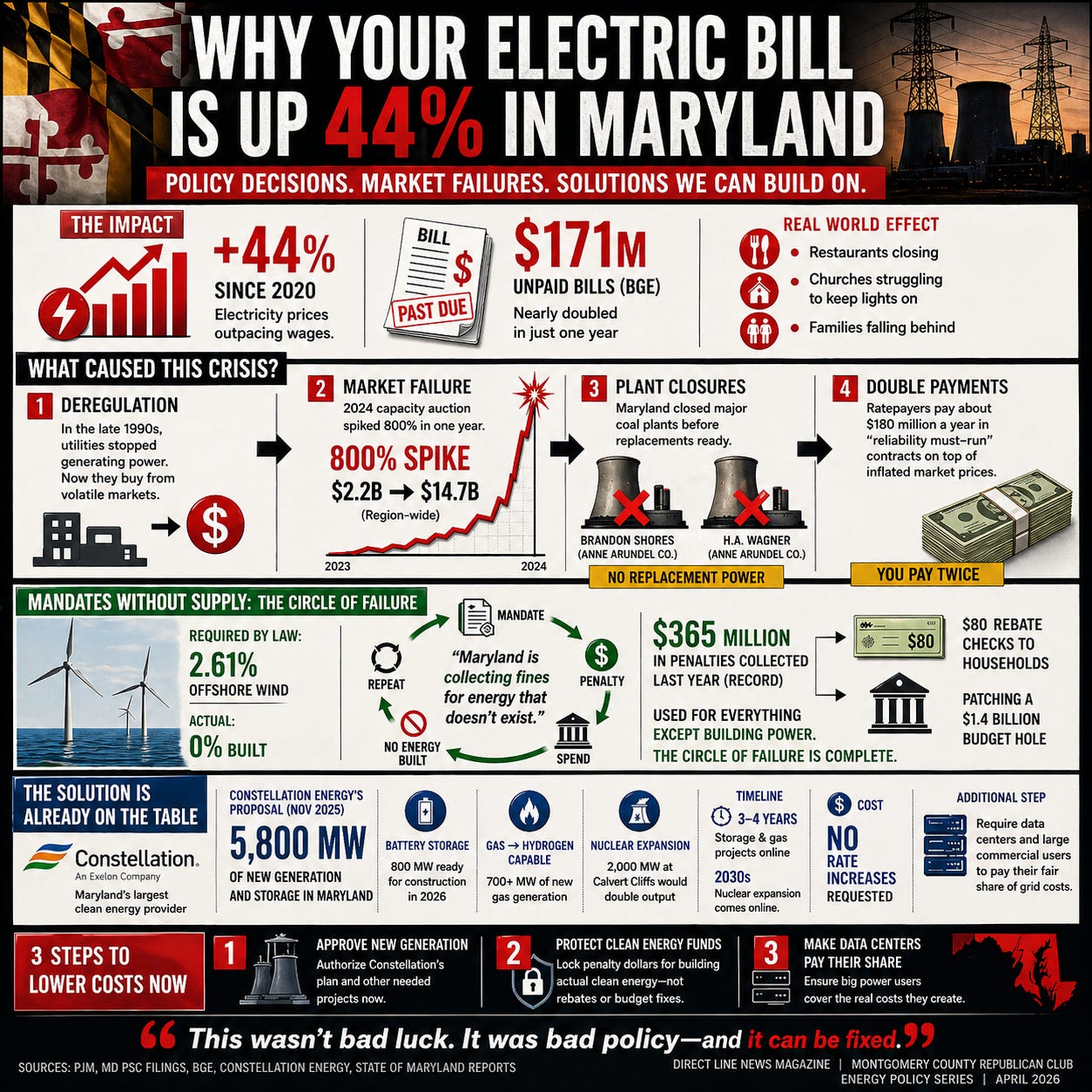
Maryland residential electricity rates have climbed 44 percent since 2020. Baltimore Gas and Electric customers absorbed an $18 monthly increase in June 2025 alone. The regional grid nearly failed last summer, when a single aging oil-fired generator in Anne Arundel County was the only thing standing between Central Maryland and rolling blackouts. Customer arrears at BGE jumped from $97 million to $171 million in twelve months. Businesses are closing. Churches cannot pay their utility bills. Families are choosing between groceries and heat.
And the Governor’s response was to hand out a rebate check worth roughly five weeks of elevated bills.[1]
Good governance demands more than that. It demands an honest accounting of how we got here, who made the decisions that got us here, and a specific plan for getting out. What follows is that accounting.
A Crisis Built in Annapolis
Start with the basics. Maryland imports roughly 40 percent of the electricity it consumes, depending primarily on Pennsylvania’s surplus generation. The state’s last major coal plant, Brandon Shores, filed to close in 2025. The regional grid operator, PJM Interconnection, looked at that closure and found that the lights in Baltimore would literally go out. So PJM placed Brandon Shores on an emergency contract, keeping it alive and billing Maryland ratepayers approximately $145 million per year for the privilege of maintaining a plant they were told would be gone.
That is not a market failure. That is the predictable result of accelerating a retirement before any replacement capacity existed.[2]
The 2024 PJM capacity auction then made things measurably worse. PJM excluded Brandon Shores and a second plant, H.A. Wagner, from the supply calculations used to set regional prices. Less apparent supply meant higher prices. Maryland’s own Office of People’s Counsel estimates that exclusion added five billion dollars to the auction cost across the region. Ratepayers ended up paying twice: once through the emergency contract keeping the plants alive, and again through the inflated auction prices that resulted from pretending those plants did not exist.
The 2025 auction hit the regulatory price cap at $329 per megawatt-day. FERC had to intervene to prevent it from going higher still. Without the cap, it would have cleared at $388.[3]
Two consecutive record-breaking auctions. Both directly traceable to specific decisions by specific people.
Maryland chose deregulation, aggressive mandates without adequate supply, and a clean energy fund that was raided for budget relief rather than invested in actual clean energy. Every one of those choices has a price. That price lands in your mailbox every month.
Maryland’s Renewable Portfolio Standard has been collecting compliance penalties at a record pace. Electricity suppliers paid $365 million in alternative compliance payments in 2024 alone, the largest total in the program’s history. Under state law, that money is supposed to fund new renewable energy construction in Maryland. Instead, substantial portions have been diverted to cover budget shortfalls and fund the very ratepayer rebate programs the Governor offered as political relief.
The result is a perfectly circular failure. Suppliers pay penalties for not building enough renewables. The penalty money is spent on something else. The renewable shortage continues.[4]
The Virginia Comparison No One Wants to Make
There is a state that borders Maryland, faces the same regional electricity grid, and has not experienced the same rate catastrophe. That state is Virginia.
Virginia kept a regulated, integrated utility model when Maryland deregulated in the late 1990s. Dominion Energy generates most of its own power. When PJM capacity prices spike, Virginia customers are largely shielded because their utility is not buying power at auction prices the way Maryland’s suppliers are. In Maryland, every household and every small business is fully exposed to whatever PJM’s volatile wholesale market produces.
This is not ideological. It is structural. Good governance requires asking whether a 25-year experiment is working. In Maryland’s case, the answer is plainly no.[5]
The state mandates that 52.5 percent of its electricity come from renewable sources by 2030. The actual renewable share of the grid today is 7 percent. Natural gas provides 48 percent. Nuclear provides 43 percent. Those are the fuels keeping the lights on while the state’s policy apparatus pretends otherwise. Mandates that outrun physical reality by a factor of seven are not energy policy. They are a fee schedule.
Big Tech Gets the Power. You Get the Bill.
Data centers are the invisible accelerant in this crisis. The AI boom has turned Northern Virginia into the data center capital of the world, and those facilities require enormous amounts of electricity around the clock. Preliminary utility forecasts project data centers requiring more than 50 gigawatts of peak capacity by 2030, enough to serve every home in New Jersey, Pennsylvania, Ohio, Virginia, and Maryland combined.
PJM’s own independent market monitor proposed a straightforward solution: require data centers to bring their own power before connecting to the grid, and do not let speculative demand forecasts inflate capacity auction prices for ordinary customers.[6]
PJM cannot enforce that proposal unilaterally. Maryland’s legislature can. FERC issued a landmark ruling in December 2025 establishing that data centers co-located with power plants must take direct responsibility for their transmission costs. Maryland should build on that federal foundation now, requiring any commercial customer seeking more than 20 megawatts of new grid connection to demonstrate that they can be served reliably without pushing costs onto families and small businesses.
Small businesses in Rockville did not create the AI revolution. Seniors in Silver Spring did not build the data center economy. They should not be subsidizing it through their utility bills.
The solution is not hypothetical. It is sitting on the table, already proposed, already engineered, already costed, and offered without a request for rate increases. The question is whether Maryland’s leaders will say yes.
The Solution Is Already on the Table
In November 2025, Constellation Energy, Maryland’s largest clean electricity producer, presented the state with a specific, costed proposal: up to 5,800 megawatts of new generation and battery storage, without seeking rate increases. The plan covers 800 megawatts of battery storage deployable within two years, 714 megawatts of new gas-fired generation designed for eventual conversion to hydrogen, and a long-term nuclear expansion at Calvert Cliffs that could effectively double the site’s output. Constellation’s CEO put it directly: billions of dollars of new investment in Maryland, without asking customers to pay more.
The Maryland Public Service Commission moved to fast-track the gas and storage components in December 2025. That is the right instinct. Full commitment is what is needed now.[7]
On nuclear, the math is unforgiving. Calvert Cliffs provides 43 percent of Maryland’s electricity today. It is clean, it runs continuously, and it performs during winter storms and summer heat waves alike. Unit 1 expires in 2034. Unit 2 expires in 2036. The relicensing application takes five to seven years to process through the Nuclear Regulatory Commission. If Maryland does not file that application before 2027, the calendar makes the decision rather than the legislature. Losing Calvert Cliffs without a replacement would wipe out more clean generation than all of Maryland’s offshore wind ambitions combined.
The Trump administration’s Department of Energy has fast-tracked eleven advanced reactor pilot projects nationwide. Maryland has federal military installations that are qualified sites for small modular reactors. The opportunity is real and time-sensitive.[8]
Fixing the broken compliance fund is equally urgent and equally straightforward. Maryland must stop raiding its clean energy account for short-term budget relief. The $365 million collected in alternative compliance payments in 2024 should be locked by statute into in-state renewable construction. When penalty money builds actual solar farms and storage facilities in Maryland, the compliance gap closes year by year. When it disappears into general fund transfers, the penalty cycle continues and ratepayers pay the cost forever.
This Is a Governance Test
Good governance is not complicated. It means telling the truth about a problem, identifying who is responsible for solving it, and demanding accountability when they do not.
The truth about Maryland’s energy crisis is that it was built deliberately, one policy choice at a time: deregulation that left consumers fully exposed to a volatile market, mandates that outpaced supply by a factor of seven, emergency contracts that forced ratepayers to pay twice for the same plants, and a clean energy fund that was treated as a budget reserve. None of that happened accidentally. It happened because the people making those decisions faced no political consequences for making them.
The accountability moment is now. Maryland’s legislature returns in January 2027. The Constellation proposal needs full approval across all components. A Data Center Accountability Act needs to reach the floor. The alternative compliance fund needs a statutory lock that cannot be waived by executive order. The Calvert Cliffs relicensing application needs to be filed before the window closes. Not one of these actions requires new technology or new money. They require decisions.
Governor Moore said in December 2025 that no governor can lower energy prices. He is wrong. Governors who build supply, close fund loopholes, require data centers to bear their own costs, and file nuclear relicensing paperwork on time can absolutely lower energy prices. The limitation is not structural. It is political.[9]
Maryland families are not waiting for a policy seminar. They are waiting for someone to govern. The tools exist. The partners are ready. The plan is written.
The only thing missing is the decision to act.
ENDNOTES
1. Maryland Governor Wes Moore: Next Generation Energy Act Signing Statement and Summary of Ratepayer Rebate Provisions, May 2025. https://governor.maryland.gov/news/press/pages/governor-moore-senate-president-bill-ferguson-and-house-speaker-adrienne-a-jones-roll-out-dollar200-million-in-energy-bill-.aspx
2. Maryland Office of People’s Counsel: Resource Adequacy Frequently Asked Questions, February 2026 Update on Brandon Shores RMR Contract. https://opc.maryland.gov/Portals/0/Resource%20Adequacy%20FAQs%20update%20February%202026%20(1).pdf
3. PJM Inside Lines: 2025 Year in Review, Capacity Market Rules and Record $329 Per Megawatt-Day Clearing Price. https://insidelines.pjm.com/2025-in-review-pjm-market-rules-support-efficiency-resource-adequacy/
4. Baltimore Banner: As Maryland Lags Behind Climate Goals, Governor Moore Proposes Raid of Clean Energy Fund to Close $1.4 Billion Budget Gap, March 2026. https://www.thebaltimorebanner.com/environment/climate-change/maryland-clean-energy-fund-wes-moore-budget-2026
5. Technical.ly Baltimore: PJM Decisions on Data Centers Could Heighten Electricity Strain in Maryland, December 2025. https://technical.ly/civics/pjm-data-center-electric-grid-ferc-proposal/
6. Power Engineering: Constellation Targets 5,800 MW of New Gas, Nuclear and Battery Storage in Maryland Without Rate Increases, November 2025. https://www.power-eng.com/gas/constellation-targets-5-8-gw-of-new-gas-nuclear-and-battery-storage-in-maryland/
7. Energy Tech: DOE Announces Fast-Track Program for Small Modular Reactors, Targeting Operational Status by 2026, June 2025. https://www.energytech.com/distributed-energy/article/55298345/talk-about-fast-track-doe-wants-operational-smrs-by-july-2026
8. Governor Moore Signs Executive Order on Energy Affordability, Acknowledges Plan Will Not Lower Bills in the Short Term, December 2025. https://governor.maryland.gov/news/press/pages/governor-moore-signs-executive-order-to-lower-energy-costs,-protect-maryland-families,-and-deliver-affordable-energy-soluti.aspx
Eric Williams is a contributing columnist to Direct Line News, covering good governance, state energy policy, and public accountability.